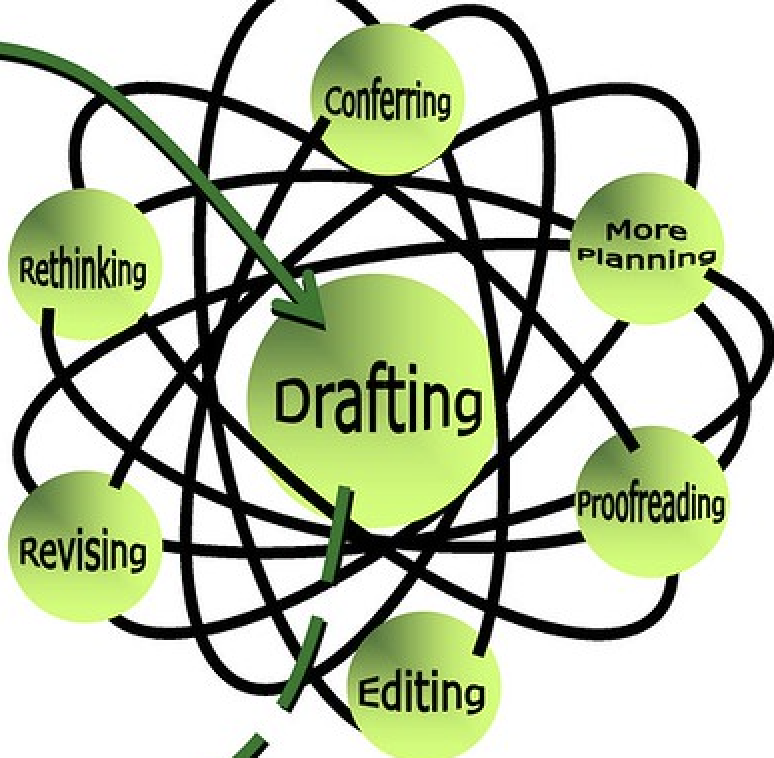
What is the purpose of writing in a college or university? Why will the practice of writing be important to you as a student, a learner, a human, and a participant in society? What is writing, beyond the ostensibly simple idea of putting words on a page? How should we engage in this act of writing, in order to produce the best result? What do you gain from engaging in the multi-step, iterative, non-linear writing process? In this course, we will interrogate the product of “college writing” in its institutional context while engaging in the process of how to do it ethically and productively.
RHET103 introduces students to common genres, tools, and skills of academic writing that will support you as a reader-writer-researcher through your college education and beyond. The course proceeds through a sequence of scaffolded assignments. By “scaffolded,” I mean that each assignment (and each lesson) builds on the one before it. Thus, it is imperative that you show up ready to learn, engage, and retain your learning from Day One. “Scaffolding” also refers to the fact that I break larger assignments into smaller incremental tasks. This is why you have some writing due every single day of the course. We will also engage in the writing process during class-time in some form, including reading, listening, discussing, free-writing, drafting, reconsidering, revising, re-writing, giving and receiving feedback, and more.
In Unit 1, we will learn (or review) how to summarize, paraphrase, quote, and cite the ideas of others and to integrate multiple others’ ideas into your own writing. We will also engage in thoughtful discussion and writing about the relationship between language use, identity, and social power, as these facets are inextricably bound with the acts and effects of writing. My expectation is that as a college student and college writer, you will show up for class ready to self-reflect, to be curious about the experiences and knowledges of others, to challenge your preconceived notions, and to consider how your unique position in the world has implications for how you read and write. This is hard, vulnerable work! So I will do my best to help you create a classroom community that can support this kind of rigorous intellectual and emotional work.
In Unit 2, you get to choose a social controversy that you are interested in to pursue through the end of the course. Unit 2 will guide you through the (not necessarily linear) stages of choosing a topic, defining an issue or controversy, formulating a research question, conducting research across credible scholarly and popular sources, composing a literature review, and finally, composing a position paper in which you articulate a clear, specific, arguable thesis statement and support it with persuasive, ethical argumentation.
In Unit 3, we will move from an academic context for our writing to a public context. After considering a variety of public-facing genres, you will get to choose the best genre to achieve your desired aim. Building from your position paper, you will compose a text in your chosen genre that aims to achieve some outcome supported by your research. You will explain in a rhetorical analysis of your own text just how your text is designed to achieve this aim.
My goal is that you will leave this class feeling confident about your ability to read carefully and critically, question and evaluate the credibility of sources, formulate myriad questions and inquire systematically about complex topics of interest, develop a well-supported position on a given issue, and use rhetorically strategic writing across academic and public genres to contribute ethically to society. It is also my goal that you will leave the class with a more robust practice of self-reflection and rhetorical inclusion.
- Profesor: Brittany Starr